2.4 The Energy Ecosystem

Energy is the fundamental proxy unit of the WeFi ecosystem, serving as the "synthetic gas" that powers the transition from traditional banking to a decentralized, onchain future. It bridges the gap between the native $WFI token and WeFi products, ensuring that value is driven by actual product usage rather than speculation.

The Role of Energy

Energy is the operational fuel for the platform: burn it to reduce or eliminate fees. It is also a loyalty filter: Energy is used to acquire additional mining power and unlock a suite of premium benefits. Finally, it acts as a value stabilizer: Energy costs are programmatically stable and non-volatile, shielding users from $WFI price swings. While not fixed, the price follows a predictable growth model tied to global ecosystem activity. Comprehensive service packages, which bundle premium cards with various banking and lifestyle products, are provided through Subscription tiers.

Function
Description

Synthetic Gas

Acts as the operational fuel burned to offset or completely eliminate platform fees for asset transfers, card payments, and internal swaps.

Mining Power Boost

Energy allows users to acquire additional CBM units. These fresh units have full mining power, rebalancing the user's pool alongside older, amortized units to boost total output.

Price Stability

Decouples service costs from market volatility. Platform actions are priced in non-volatile Energy terms, shielding users from $WFI token or fiat fluctuations.

Price Appreciation

The baseline value of Energy is mathematically programmed to grow, increasing by +$0.10 for every $1,000,000 burned globally through ecosystem activity.

Demand Indicator

Provides a real-time metric of product maturity. New $WFI supply blocks only released when global Energy levels reach proven utility thresholds.

Sourcing Energy: The Farming Model

Energy is a proactive utility earned through participation. Users fuel their Energy Balance through two distinct pathways: Daily Farming and Advanced Farming.

1. Daily Farming (The Introductory Step)

Designed for immediate needs and consistent engagement, Daily Farming operates automatically on $WFI tokens held in the user's Account.

  • Time Factor (The Loyalty Multiplier): Rewards consistent, long-term holding. Generation efficiency increases exponentially based on the number of consecutive days $WFI remains untouched.

  • The Reset Rule (Sending Out): If a user sends any $WFI tokens out of their Onchain Banking Account, their Time Factor resets to zero. They must begin building the multiplier from the beginning.

  • The Inheritance Rule (Bringing In): New tokens added to a user's balance inherit their existing Time Factor. If a user has 100 days built up, new tokens start at 100 days, not from zero, boosting rewards instantly.

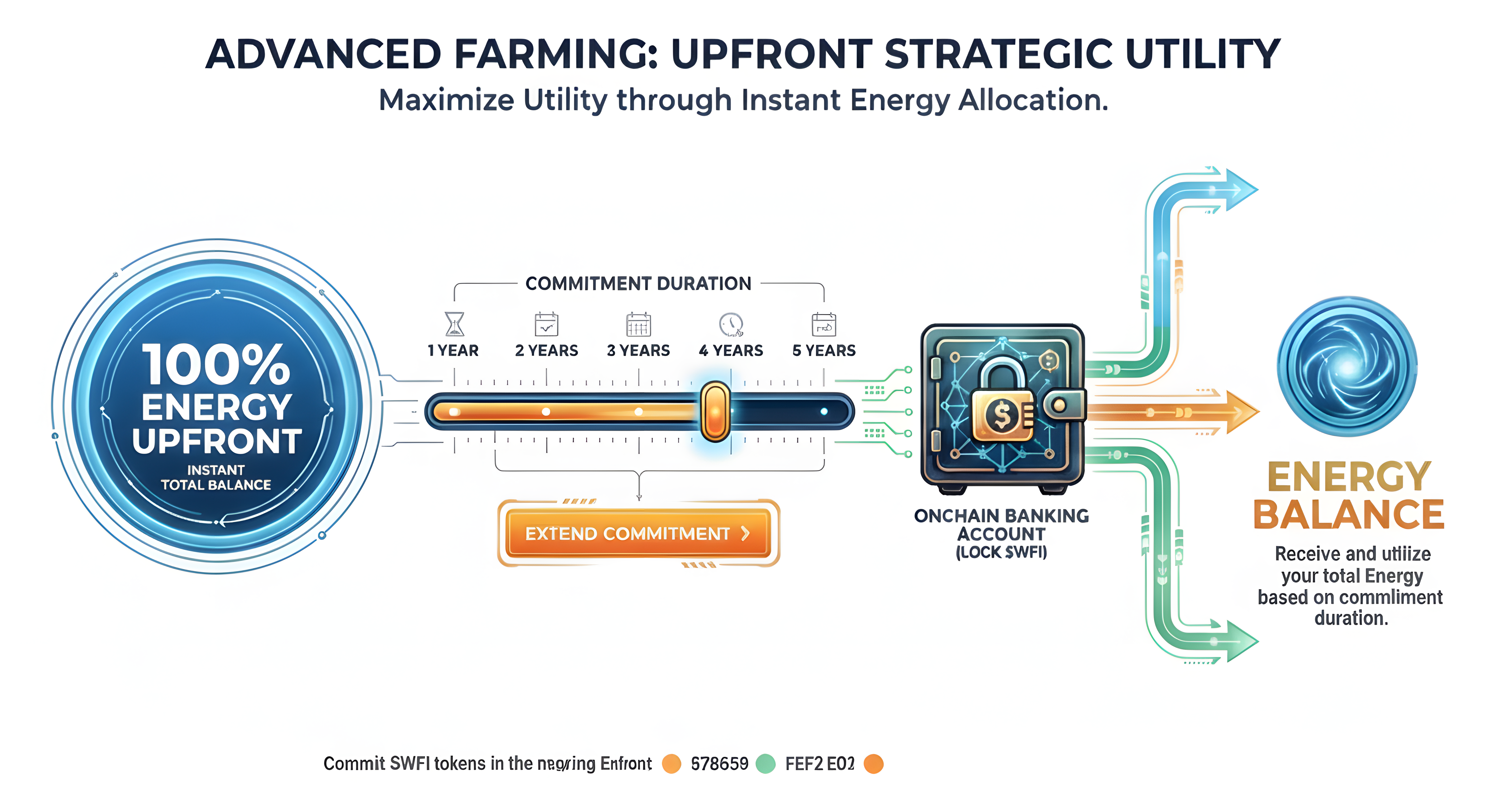
2. Advanced Farming (Strategic Commitment)

Designed for long-term status and maximum rewards, this pathway is significantly more rewarding than Daily Farming due to how the Time Factor is applied.

  • Upfront Issuance: Unlike Daily Farming where the Time Factor grows gradually day-by-day, Advanced Farming applies the maximum Time Factor for the chosen duration (1 to 5 years) immediately. All Energy for the entire period is issued upfront.

  • Rewards Superiority: Because the maximum multiplier is applied from day one, the total Energy generated over a 5-year commitment is substantially higher than 5 years of gradual Daily Farming.

  • Scalability: Users can extend their farming duration at any time to unlock additional Energy and maintain high-tier status.

  • Onchain Banking Account: Uses a separate, secured balance dedicated to pool-based farming, separating operational liquidity from long-term utility generation.

Daily vs. Advanced Farming: A Comparative Analysis

Feature
Daily Farming
Advanced Farming

Time Factor

Gradient growth (Daily)

Immediate Maximum

Energy Issuance

Accrued daily

100% Upfront

Total Rewards

Lower (due to growth curve)

Maximum (block issuance)

Flexibility

Liquid (Onchain Banking Account)

Committed (Onchain Banking Account)

Extensions

N/A (based on holding)

Extendable any time

Referral Energy: The Network Effect

Referrals drive the Community Reading metric, allowing users to accelerate their Energy generation by leveraging network activity.

The referral system operates through tiers that unlock based on user lifetime engagement. Each tier unlocked opens additional referral lines and increases the percentage of Energy rewards received from the user's network. Higher tiers provide progressively better reward percentages.

Aspect
Description

Tier Unlocking

Based on cumulative lifetime participation in the ecosystem

Reward Structure

Higher tiers unlock more referral lines and better reward percentages

Network Depth

Rewards extend across multiple referral lines depending on tier level

The Energy Burn Model

Energy price evolves with ecosystem activity. As Energy is burned through products, the global base price increases, while product-level coefficients create variation in pricing.

Energy Price Growth Rule

For every $1,000,000 of Energy burned in total across the global ecosystem, the baseline Energy price increases by +$0.10.

Energy Price Growth

Each product has a specific Energy Product Price, calculated by applying a Product Coefficient to the current global Energy Price:

PriceProduct=PriceEnergy×CoeffProductPrice_{Product} = Price_{Energy} \times Coeff_{Product}

Product Coefficients

Products that use Energy have their own Product Coefficient. This is calculated as the share of the amount of Energy burned through a specific product relative to the total amount of Energy burned:

CoeffProduct=2Collected_Energy_ProductCollected_Energy_TotalCoeff_{Product} = 2 - \frac{Collected\_Energy\_Product}{Collected\_Energy\_Total}

The system calculates Energy pricing for each product periodically and executes the burns. All burns increase the global Energy Price, creating a transparent, dynamic system that ties Energy value directly to community activity.

Technical Infrastructure & Guardrails

  • Direct to Balance: Farmed Energy goes directly to the user's balance, ready to use or allocate to products for benefits.

  • Global Reading (MSC): Total ecosystem Energy burn serves as a guardrail for Mathematical Supply Control. New blocks of $WFI are only released when Energy demand reaches specific thresholds.

Last updated